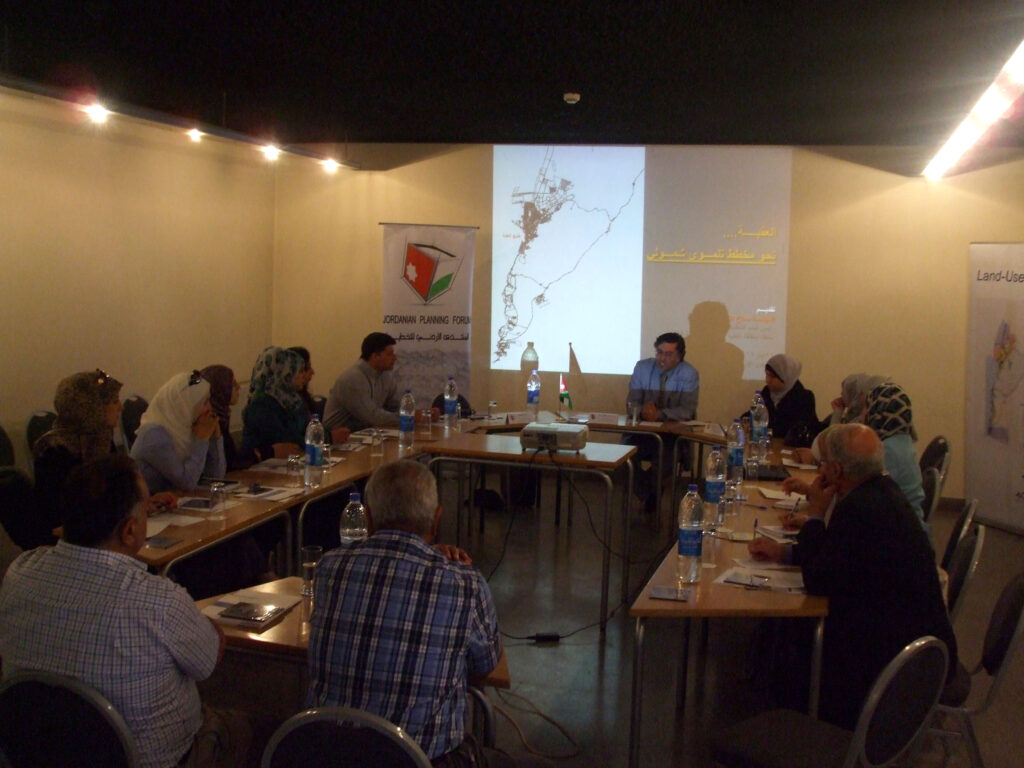
Aqaba Special Economic Zone Planning Discussion
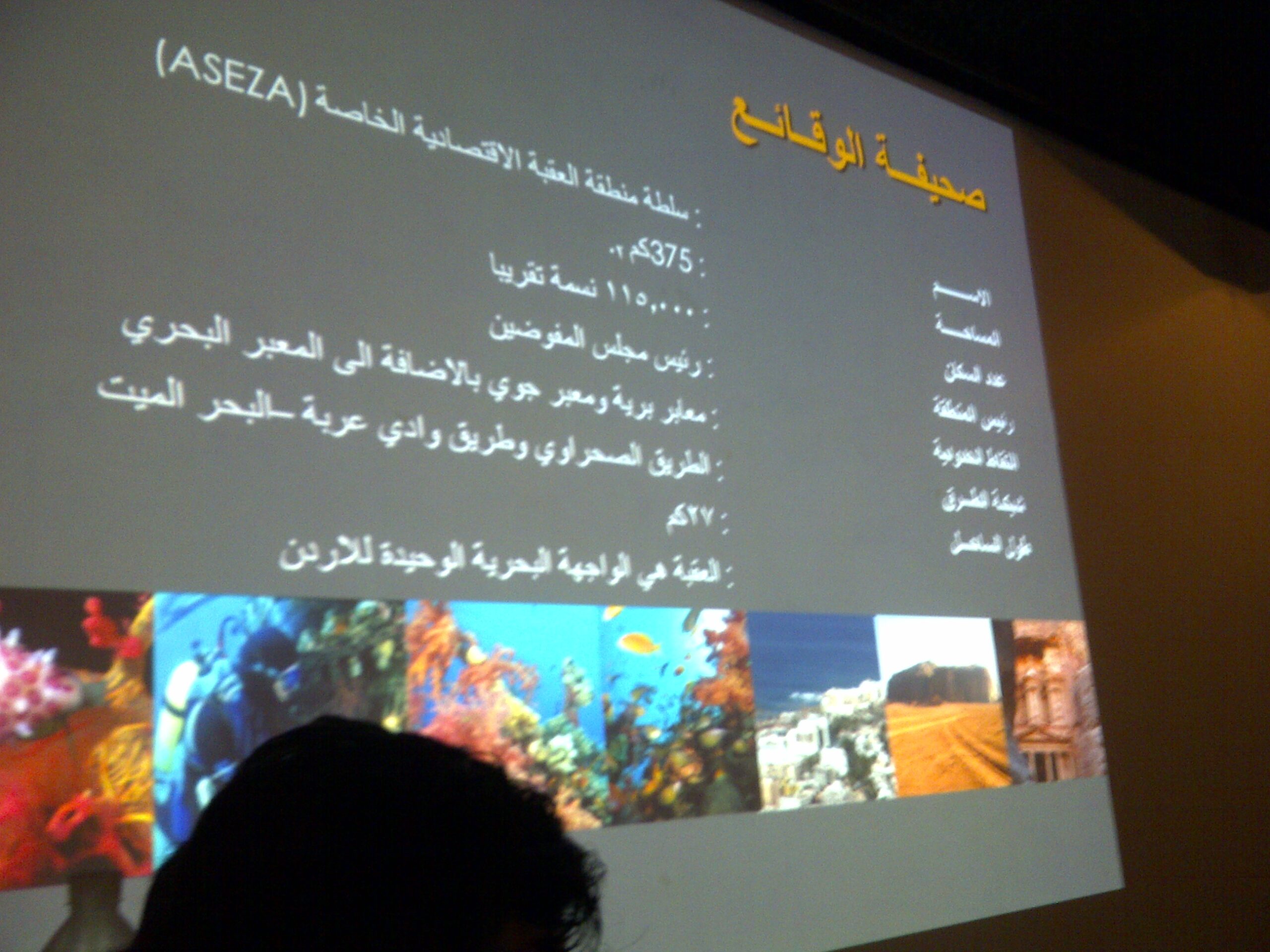
The Jordanian Planning Forum held its May 2012 event under the theme “Planning the Aqaba Special Economic Zone,” featuring a lecture by Engineer Samah Abdel Khaleq, Head of the Planning and Organization Department at the Aqaba Special Economic Zone Authority (ASEZA). Engineer Samah explained ASEZA’s organizational structure as a financially and administratively independent regulator and outlined the role of the Aqaba Development Corporation as the developer. She presented the comprehensive plan for the area, known as the “Gensler Plan,” which serves as a roadmap for ASEZA’s developmental strategies.
Engineer Samah detailed the major activities along Aqaba’s 27 km coastline, starting from Ayla Oasis in the north, which will add 17 km of waterfront, passing through the airport, the industrial city, the city center, then Hafayer and Shalala areas, Marsa Zayed (which will replace the current port), Saraya Aqaba, Yamanieh Heights, Al-Muttal, Tala Bay, the container and passenger port, the marine park, the public beach, and finally the industrial area in the south.
During the lecture, there were several interventions from the attendees, starting with the forum’s President, Dr. Murad Al-Kalaldeh, who emphasized the need to link the comprehensive plan to human development and avoid allocating land solely for luxurious investment projects accessible only to a limited segment of the population, making it difficult for the average citizen to approach them. Professor Khalis Al-Ashaab, former Dean of the Urban and Regional Planning Institute at the University of Baghdad, commented that it seemed as though Aqaba was being planned as if it were disconnected from Jordan. He stressed the necessity for the comprehensive plan to open up to the rest of Jordan and the outside world, which he found lacking in the current plan under discussion.
The attendees also focused on the Marsa Zayed project, which is expected to bring a qualitative change to Aqaba but has several planning issues. For instance, trucks are prohibited from passing through it, requiring an alternative road through the mountains that could cost hundreds of millions of dinars, potentially disrupting logistical connections between northern and southern Aqaba. Additionally, the project burdens ASEZA with the responsibility of providing complete infrastructure services, which could cost over half a billion dinars, according to Dr. Al-Kalaldeh.
The discussion highlighted the need to complete the general transportation and traffic plan to ensure smooth transport, including railway routes, cargo transport, and passenger transport for medium and small vehicles. The maritime transportation strategy, including its relationship with the passenger port and other docking stations, must also be defined. Engineer Samah mentioned that ASEZA could no longer meet the increasing demand from government institutions for land allocation on the coast due to limited space. Dr. Murad commented that this issue must be prioritized, as it is a right for public sector employees who cannot afford to vacation in foreign resorts. He questioned the value of development if it does not benefit Jordan’s citizens and improve their well-being in proportion to their income.
Engineer Bahaa Marji pointed out that the total areas designated for gated communities are large compared to other spaces, imposing a much higher social and consumer pattern than elsewhere in Jordan. He questioned who would enter these gated communities and whether the country could bear the cost of this social disparity.
Dr. Mamoun Al-Fanek, Planning Director at the Ma’an Development Company, emphasized the need to maintain a specific vision for the area’s development. He questioned the type and size of the sectors targeted in Aqaba’s comprehensive plan. Engineer Samah replied that the plan allocates 50% of the area for tourism, followed by industry and services.
The Saturday Forum concluded with praise for the establishment of the Aqaba Special Economic Zone. However, there was a strong emphasis on not being dazzled by some financial indicators showing that ASEZA exceeded its targets of attracting six billion dinars by 2006, reaching 18 billion by 2011. This does not necessarily indicate successful planning; on the contrary, it may suggest a failure to align with planning goals, leading to a potential bubble burst or sudden recession. Evidence of this is already visible with many stalled projects and the significant financial burdens placed on the state due to hasty decision-making, such as selling Aqaba Port lands without having an alternative port in place.